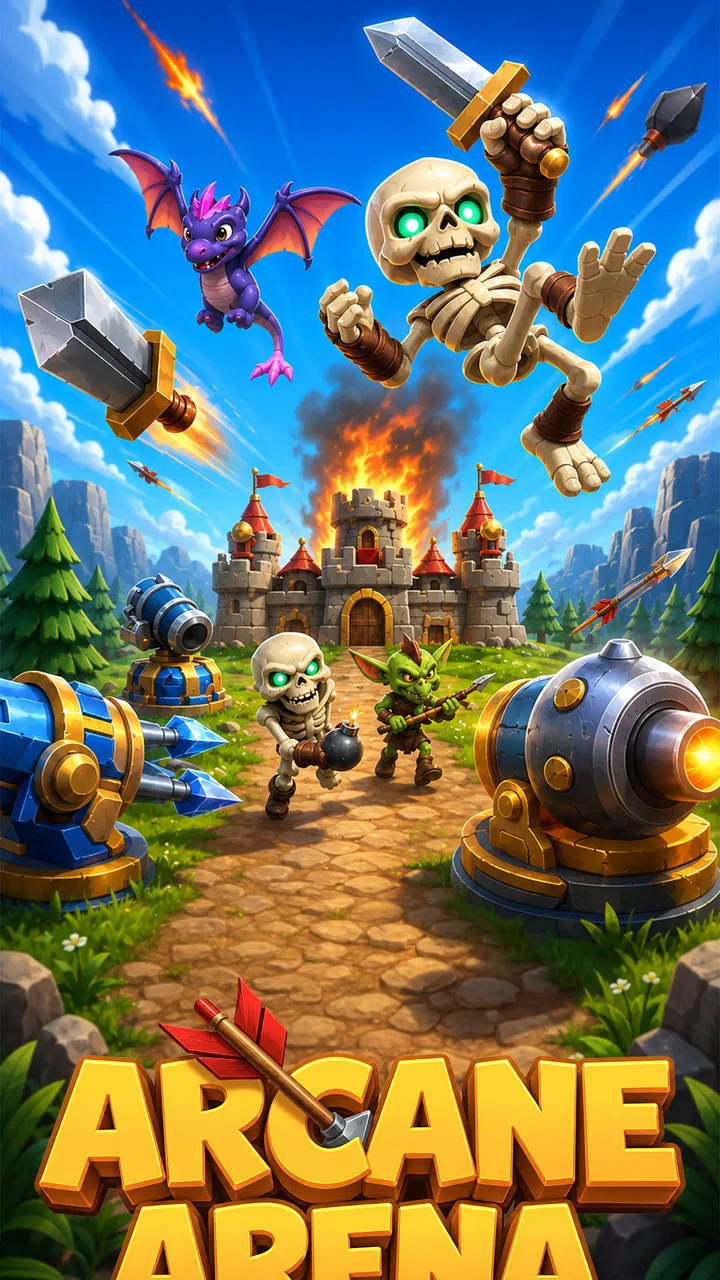
Arcane Arena: Tower Defense TD
- 4.1
- Rating
- 500.00K
- Installs
- Free
- Price

 Analysis by App-foxy
I tested Arcane Arena: Tower Defense TD with a shared-device mindset rather than treating it as a quick solo download. That changed what stood out. The game is built around tactical tower defense and real-time player-versus-player battles, so it can be enjoyable when one person wants a focused match, but it also raises practical questions in a household: who gets the device, how much attention does a match demand, and is the competitive side suitable for younger players?
My first impression was that this is not a passive strategy game where I can place a few towers and walk away. The appeal comes from making decisions while the battle develops. I have to watch the field, react to pressure and think about whether a defensive move is worth making immediately or saving for a later moment. That gives each session more tension than a standard tower defense campaign, although it also makes the game less convenient when I only have a minute or two available.
How Arcane Arena fits into a shared household
In a home where several people use the same phone or tablet, the most important practical detail is that a real-time match needs a clear block of uninterrupted attention. It is easy to imagine starting a battle while waiting for dinner or while another family member is asking to use the device, then discovering that the timing of the match makes handing it over awkward. I would treat it as a game for planned turns on a shared screen, not something to launch casually when the device may be needed at any second.
You May Also Like

 Blood Strike: 2.5 Anniversary
Blood Strike’s Loadouts Turn Every Drop Into a Tactical Gamble
A close look at Blood Strike’s custom loadouts: how fast access to signature weapons reshapes its battle royale rhythm, rewards preparation, and narrows the gap between fights.

 Pandora - Music & Podcasts
Pandora’s Music Is Easy to Start, but Harder to Recover
Pandora’s strength is its low-effort path from a seed to a station. Its weak spot is how much confidence it asks you to place in connection, setup, and quiet recovery.

 8 Ball Pool
 Is Built on Rivalries, Rematches, and Routine
A close look at the rivalries, rematches, shared routines, and unanswered safety questions that turn a quick pool match into a persistent mobile community.

 Samsung Music
’s Quiet Strength Is Playing What You Already Own
Its reach comes less from spectacle than from dependable access to a personal library. That simplicity is both the app’s strongest retention engine and its ceiling.

 AccuWeather: Weather Radar
AccuWeather Review: A Quick, Clear Forecast for Everyday Decisions
For everyday plans, the best forecast is the one you can understand quickly. AccuWeather makes rain timing, radar, and local conditions easy to act on, with a few trade-offs.

 Hill Climb Racing
Why Hill Climb Racing Still Turns Crashes Into One More Run
A tiny car, a bumpy hill and one more upgrade: Hill Climb Racing keeps resurfacing because its simple chaos makes every near-miss feel personal.
More From Our News Desk
View All News


That makes it different from slower tower defense alternatives. In a conventional campaign, I can often pause, retry a level or leave the game between waves without affecting another person. The competitive format here places more weight on the moment-to-moment exchange. If two people in the same household want to play, taking turns can work, but it is better to agree on a simple rotation before starting rather than negotiating during a battle.
There is also a useful social angle. One player can watch another and discuss why a tower placement or timing choice worked. That makes the game suitable for short strategy conversations, especially when an experienced player explains the reasoning behind a decision instead of simply taking the device away. However, watching is not the same as cooperating. The competitive structure means family members should not assume that a shared match will automatically become a cooperative activity.
For a realistic everyday example, I would use it this way: one person plays a match after school, then gives the device to a sibling only after the battle is finished. The second player can review what happened and try a different approach. That arrangement avoids interrupting a live contest and turns the game into a small strategy challenge rather than a source of arguments over whose turn it is.
Setting expectations before the first battle
The game is free to start, which removes the biggest barrier for trying it on a household device. At the same time, it includes in-app purchases ranging from $0.99 to $99.99 per item. That is a wide enough range that I would discuss spending rules before anyone begins, particularly if the device is shared or connected to a payment method. The sensible boundary is simple: play first, and do not treat optional purchases as part of the basic setup.
I also recommend deciding whether the game is being used as a personal activity or as a family activity. Those are different arrangements. If it belongs to one player, other household members should not change progress or make purchases without permission. If it is a shared activity, everyone should understand that competitive results may not transfer neatly from one person’s style to another’s. A quick conversation at the beginning prevents more friction than trying to settle ownership after several sessions.
The developer is Panteon, and the game is listed as a strategy title rather than a casual puzzle. That distinction matters for expectations. Someone looking for a relaxed, instantly understandable game may find the decision-making demanding, while a player who enjoys adapting under pressure will probably appreciate the stronger tactical focus. I would not install it on a shared device expecting every user to enjoy it equally.
The technical entry point is fairly broad: the current version is 1.038 and it supports Android 7.0 or later. That makes it practical for many older Android devices, but compatibility alone does not guarantee a comfortable shared experience. Screen size, battery condition and whether the device is already busy with other apps can matter more in daily use. On a small phone, two people watching the same battle may find the action harder to follow than on a larger tablet.
Coordination matters more than it first appears
The real-time format creates a trade-off between depth and convenience. I like that decisions have consequences while the match is active, because it prevents the familiar tower defense habit of placing a fixed setup and waiting for it to solve everything. The downside is that a player cannot always stop to explain every choice to someone watching. If the goal is teaching a younger family member, it works better to discuss the plan before the match and review the result afterward.
One useful habit is to give each session a narrow objective. Instead of trying to win every time, I might focus on observing which defensive choices create breathing room or which mistakes leave the field vulnerable. This keeps a loss from becoming an argument about skill. It also helps two players compare approaches without pretending that one match proves who is the better strategist.
Another practical tip is to keep the device holder consistent during a battle. Passing a phone back and forth can make a tense match feel chaotic and can encourage accidental taps. For a shared tablet, I would place it somewhere stable and let the active player make the decisions while the other person comments. That simple boundary preserves the competitive element without turning the screen into a tug-of-war.
Players should also think about attention, not only time. A short match can still require concentration at the wrong moment, especially if someone is trying to cook, supervise homework or answer messages. I would choose a quiet window for competitive play and use other games for situations where interruptions are unavoidable. This is one of the clearest cases where a slower, offline-style tower defense alternative may be the better choice.
Age, trust and the competitive setting
The content rating is Everyone 10+, so I would place it in the category of games that may suit older children with ordinary household guidance, rather than handing it to a very young child without discussion. The rating does not tell me how a particular child will react to losing, competing or wanting optional items, so the family context still matters more than the label alone.
For a child who enjoys planning, the game can provide a useful way to practice delayed decisions. A defensive move may look attractive immediately but create a weaker position later, and that kind of trade-off is more meaningful than simply tapping through a level. I would encourage the child to explain why a choice was made, not just celebrate the result. That turns the game into a conversation about planning rather than a simple win-or-lose test.
For a child who becomes upset after repeated losses, I would be more cautious. Real-time player-versus-player battles can make failure feel personal even when it is only part of learning the game. In that situation, a solo strategy game with pause options and a more predictable progression may be a better fit. Arcane Arena is not the right choice merely because it is free or because the age label appears reasonable.
Trust also includes spending. Since purchases are available, the device owner should make the payment boundary explicit. I would not rely on a child guessing what is acceptable, and I would not treat a free download as proof that the entire experience will remain cost-free. A household can enjoy the game without buying anything, but that decision should be deliberate rather than accidental.
There is a second trust issue with shared progress. If several people play through one installation, each person may interpret success differently and may want to experiment. That can be fun when everyone agrees, but frustrating when one player expects a carefully managed personal account. I would use a separate device or a clearly assigned play schedule if preserving individual progress is important, rather than assuming that a shared screen will provide clean boundaries.
What the strategy feels like in practice
As a strategy game, its strongest quality is the pressure to connect placement with timing. I am not simply building a static maze and waiting for the result; I am responding to an opponent and trying to make choices that remain useful as conditions change. That gives the battles a sharper identity than many familiar tower defense games, which often emphasize memorizing a successful layout for each stage.
The trade-off is that the competitive layer can make experimentation feel expensive in attention. In a traditional campaign, I can test an unusual arrangement, learn from the failure and restart at my own pace. Here, experimentation happens under pressure. I would recommend beginning with a conservative approach, learning how the battlefield responds, and only then trying riskier decisions. That is more productive than changing everything at once after a loss.
A non-obvious benefit of the format is that it exposes whether a strategy is genuinely adaptable. A setup that works against predictable waves may not be enough when another player forces a different response. If you enjoy analyzing why a plan failed, this is where the game earns its place. If you prefer to perfect one solution and repeat it, the real-time battles may feel less satisfying than a level-based tower defense title.
I also found that the game is better suited to focused sessions than background play. Music, conversation and interruptions can pull attention away from the decisions that make the battles interesting. That is not a flaw in itself, but it changes where I would play it. On a shared family tablet, I would choose a common area for occasional planned matches; on a personal phone, I would avoid launching it when I know I may be interrupted.
Who should choose it and who should skip it
I would recommend Arcane Arena to players who specifically want tower defense with a competitive, tactical edge. It is a good match for someone who enjoys adjusting a plan while the battle is underway and who can accept that not every session will end in a win. The average rating is 4.3 from around 11K ratings, and the game has passed 100K installs, which suggests that it has found an audience beyond a tiny group of experimenters.
I would be less enthusiastic for someone seeking a calm game for short interruptions, a purely offline routine or a story-led campaign. The real-time structure is the central attraction, so it is also the central limitation. Players who dislike pressure, competitive uncertainty or the possibility of facing a stronger strategy may get more enjoyment from a traditional tower defense game with fixed stages and generous pause options.
It may work well for two people in a household who enjoy comparing decisions, but I would not present it as a guaranteed family game. Different ages and temperaments can produce very different reactions to the same match. One person may see a loss as useful information, while another may see it as a reason to stop playing. The game is best introduced with modest expectations and clear turn-taking.
The free price is helpful for testing that fit. I would install it, play enough to understand whether the live battles feel exciting or stressful, and only then decide whether it deserves regular space on the device. Because purchases are available, I would keep the first stage focused on learning the game rather than improving the experience through spending.
My household verdict
After looking at it as both a player and a shared-device reviewer, I see a focused strategy game rather than a universal household pastime. Its real-time battles give tower defense more urgency, and I appreciate the way they reward adaptation instead of a single memorized layout. That makes it more engaging for competitive players and more demanding for anyone who wants a game that can be paused at any moment.
For a shared home, my recommendation is to establish three boundaries: decide who owns the progress, agree on when live matches can be played, and set a firm rule for optional purchases. Those decisions are more important than choosing the perfect device. They protect the social side of the experience and make it easier for different players to enjoy the same installation without stepping on one another’s plans.
I would choose it for a household with older children or adults who enjoy discussing tactics, taking turns and learning from losses. I would skip it for a very young player, a family that needs a completely interruption-friendly game, or anyone looking for a quiet solo tower defense campaign. The best reason to try it is its tactical pressure, not its free entry point.
Overall, Panteon’s game is worth trying when real-time strategy is exactly what you want. It has enough tension to make each decision feel meaningful, but that same tension demands attention, patience and sensible account boundaries. In my experience, it works best when treated as a planned competitive activity rather than a background pastime. For the right player, that focus is the appeal; for everyone else, a slower alternative will probably be the more comfortable choice.
FAQs for Arcane Arena: Tower Defense TD
01What is the main objective of Arcane Arena: Tower Defense TD?
Arcane Arena: Tower Defense TD challenges players to strategically place towers and units to defend their territory against waves of mystical creatures. The main objective is to prevent enemies from breaching your defenses by using a combination of different tower types and magical powers, ensuring the survival of your realm.
02Is Arcane Arena: Tower Defense TD free to play?
Yes, Arcane Arena: Tower Defense TD is free to download and play on both Android and iOS platforms. However, it includes in-app purchases that allow players to enhance their gaming experience, such as unlocking special towers, acquiring unique abilities, and removing ads.
03What types of towers are available in the game?
The game offers a variety of towers, each with unique abilities and upgrades. Players can choose from elemental towers like fire, ice, and lightning, each designed to counter specific enemy types. As players progress, they can unlock more powerful towers and upgrade existing ones to increase their defensive capabilities.
04Does Arcane Arena: Tower Defense TD require an internet connection?
Arcane Arena: Tower Defense TD can be played offline, making it perfect for on-the-go gaming without requiring constant internet access. However, an internet connection is recommended for downloading updates, accessing leaderboards, and making in-app purchases.
05Can I play Arcane Arena: Tower Defense TD on multiple devices?
Yes, you can play Arcane Arena: Tower Defense TD on multiple devices. By linking your game account to a social media account or email, you can save your progress and easily switch between devices, ensuring a seamless gaming experience across all your platforms.
Pros
- Engaging strategic gameplay keeps you hooked.
- Stunning graphics enhance the immersive experience.
- Regular updates with new levels and features.
- Intuitive controls make it easy for beginners.
- Variety of towers and upgrades for customization.
Cons
- In-app purchases can be quite expensive.
- Occasional lag on older devices.
- High battery consumption during gameplay.
- Limited offline functionality.
- Requires constant internet connection.

Arcane Arena: Tower Defense TD
Gallery